
A compliance-first look at Canadian market entry for global food brands navigating an increasingly complex regulatory environment
For years, conversations about food exports have often focused on one question: How do we get into Europe?
Today, a different question is gaining traction among food businesses, trade organizations, and export advisors:
Is Canada becoming one of the smartest markets to enter first?
The answer has less to do with tariffs or geography and more to do with something that increasingly determines export success worldwide: regulatory readiness.
As global markets introduce new requirements around sustainability, traceability, environmental claims, packaging, due diligence, and supply-chain accountability, food businesses are discovering that market expansion is no longer just a sales strategy. It is a compliance strategy.
Against that backdrop, Canada is attracting growing attention—not because it is an easy market, but because it offers something many exporters value: a transparent, rules-based regulatory framework that allows businesses to build strong compliance foundations while accessing a sophisticated consumer market.
For food businesses looking to expand internationally, Canada is increasingly being viewed as a strategic destination where growth and regulatory readiness can develop together.
Global Food Trade Is Entering a New Compliance Era
Food safety remains the cornerstone of international trade, but it is no longer the only consideration.
Around the world, regulators are expanding their focus to include sustainability, responsible sourcing, environmental performance, packaging impacts, supply-chain transparency, and consumer protection.
In the European Union, for example, businesses are preparing for requirements related to deforestation-free supply chains, packaging sustainability, environmental claim substantiation, and increasingly detailed compliance documentation.
These developments reflect legitimate public policy goals. Consumers want more transparency. Governments want greater accountability. Retailers want stronger supply-chain visibility.
However, the result is that exporters increasingly need more than a great product and a willing buyer.
They need systems.
They need documentation.
They need traceability.
And they need confidence that their products can withstand regulatory scrutiny before they enter a new market.
For many small and medium-sized food businesses, that reality is changing how export strategies are developed.
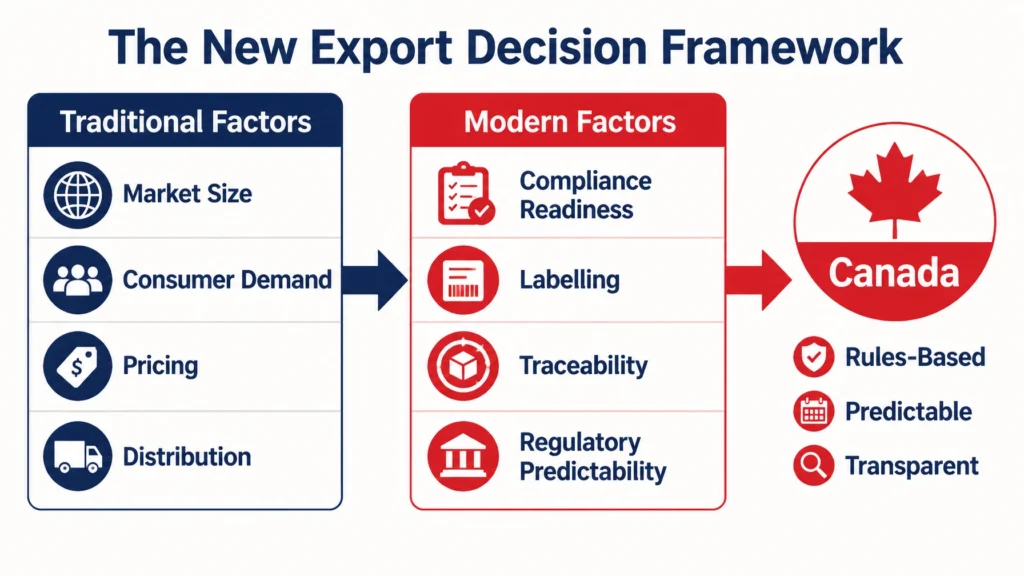
Why Canada Is Standing Out
Canada’s appeal is not based on lower standards.
In fact, Canada’s food regulatory system is among the most respected in the world.
What makes Canada attractive is the combination of rigorous standards and a clear regulatory structure.
Businesses entering the Canadian market can generally identify the key requirements they must address:
- Import licensing requirements
- Food safety obligations
- Preventive controls
- Traceability systems
- Recall preparedness
- Product classification
- Label compliance
- Ingredient and compositional requirements
- Commodity-specific import requirements
These expectations are significant, but they are also predictable.
Companies that invest in understanding the rules can build a practical roadmap for market entry.
That predictability matters.
For growing food businesses, uncertainty is often more expensive than regulation itself.
Canada Rewards Preparation
One of the most common misconceptions in international trade is that compliance begins after a buyer is secured.
In reality, successful exporters build compliance into their growth strategy long before their first shipment leaves port.
Canada rewards this approach.
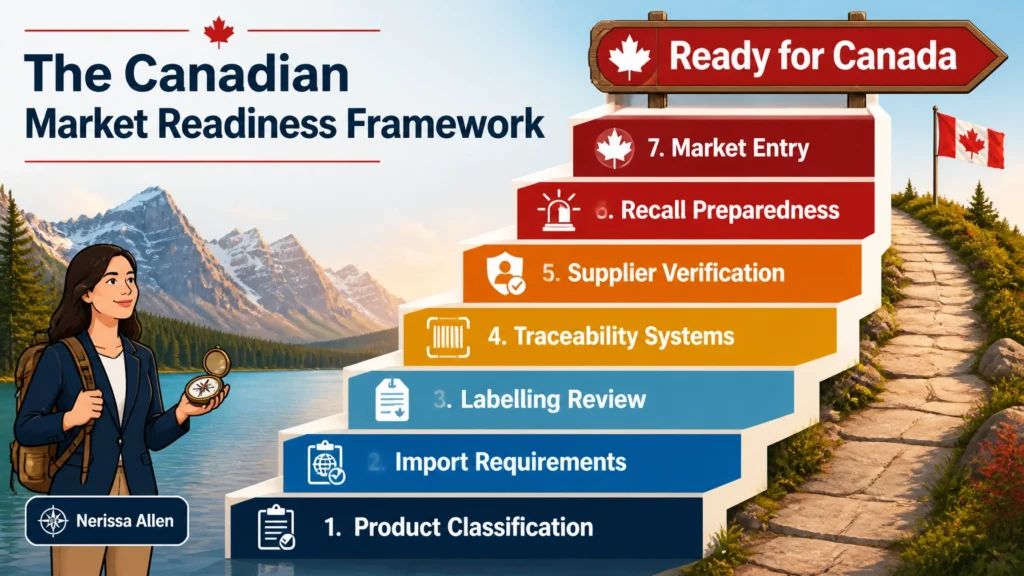
Businesses that take time to understand product requirements, verify suppliers, review labels, establish traceability systems, and prepare documentation are often better positioned for long-term success.
This is particularly important for emerging food brands.
Many businesses focus heavily on product development and marketing while underestimating the operational systems required for export growth.
The companies that scale successfully tend to be those that treat compliance as a business asset rather than a regulatory obligation.
A Strategic Market for Growing Food Brands
Canada offers several advantages that make it attractive to international food businesses.
A Diverse Consumer Base
Canada’s multicultural population creates demand for a wide variety of food products, including specialty foods, ethnic foods, health-focused products, premium ingredients, and innovative food concepts.
This diversity creates opportunities for businesses from around the world to introduce products that already have strong cultural relevance and consumer demand.
A Stable Regulatory Environment
While regulations evolve, Canada’s food regulatory framework is well established and supported by extensive guidance.
Businesses can access information on licensing, labelling, food safety, import requirements, and commodity-specific obligations through recognized government channels.
This allows exporters to make informed decisions and plan investments with greater confidence.
A Gateway for Export Growth
For many companies, entering Canada is not the end goal.
It is part of a broader international growth strategy.
The systems required to succeed in Canada—traceability, documentation, supplier verification, preventive controls, recall readiness, and label compliance—are the same systems that support success in other sophisticated markets.
In that sense, Canada can serve as a valuable stepping stone for businesses pursuing broader international expansion.
Why Compliance Readiness Is Becoming a Competitive Advantage
Historically, companies competed primarily on price, quality, and brand recognition.
Today, compliance readiness is becoming a competitive differentiator.
Importers, distributors, retailers, and foodservice buyers increasingly want confidence that suppliers understand regulatory expectations and can demonstrate compliance.
This is particularly important when buyers are managing their own risk.
Businesses that can provide clear documentation, maintain strong records, respond quickly to information requests, and demonstrate regulatory preparedness often gain a competitive advantage.
Compliance is no longer a back-office function.
It is becoming part of market access itself.
What Food Businesses Should Do Before Entering Canada
Before pursuing Canadian market entry, food businesses should conduct a comprehensive readiness assessment.
Key questions include:
Do we understand our product classification?
Different products can trigger different regulatory requirements. Understanding how a product is classified is often the first step in determining obligations.
Are our labels market-ready?
Labelling remains one of the most common sources of compliance issues. Businesses should ensure that all required information is accurate, complete, and presented appropriately for the Canadian market.
Do we have effective traceability systems?
Being able to identify where products came from and where they were distributed is a fundamental component of modern food regulation.
Can we support our claims?
Whether claims relate to nutrition, ingredients, sourcing, or sustainability, businesses should ensure they have evidence to support what appears on packaging and marketing materials.
Are our suppliers properly documented?
Supplier verification is becoming increasingly important across global markets. Maintaining organized records and specifications can reduce risk and improve responsiveness.
Are we prepared for a recall scenario?
Recall preparedness is not simply a regulatory requirement. It is an important component of risk management and brand protection.
The Most Successful Exporters Think Beyond Their First Shipment
Market entry is often treated as a destination.
In reality, it is the beginning of a long-term relationship with regulators, customers, distributors, and consumers.
The most successful food businesses understand that export growth requires more than securing shelf space.
It requires building systems that support consistency, accountability, and continuous compliance.
Canada provides an environment where those systems can be developed and strengthened while serving a sophisticated consumer market.
That is one reason more food businesses are including Canada in their international growth strategies.
Canada’s Opportunity in a Changing Global Market
As global regulatory expectations continue to evolve, businesses are becoming more selective about where they invest their time, resources, and compliance efforts.
Markets that combine strong consumer demand with regulatory clarity are increasingly attractive.
Canada is well positioned to benefit from that shift.
For food businesses seeking sustainable growth, Canada offers more than market access.
It offers the opportunity to build the operational discipline, regulatory confidence, and compliance maturity that support long-term international success.
And in today’s food industry, those capabilities may be just as valuable as the product itself.
About the Author
Nerissa Allen is a former CFIA National Import Manager with more than 20 years of experience in food regulation, import compliance, enforcement, and market-entry strategy. Through NerissaAllen.com, they help international food brands, Canadian importers, and food business organizations navigate Canadian regulatory requirements with confidence before products reach the border.
Call to Action
Planning to enter the Canadian food market?
Before your first shipment leaves port, ensure you understand the regulatory obligations that apply to your product, supply chain, and business model.
Book a Regulatory Clarity Call to identify potential compliance gaps, understand your market-entry pathway, and build a stronger foundation for successful Canadian market access.